
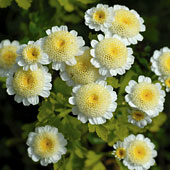
Feverfew is a short bush with daisy-like flowers. It comes originally from the Balkan mountains of eastern Europe, but now grows throughout Europe, North America, and South America.
The dried leaves and sometimes flowers and stems of feverfew are used to make supplements, including capsules, tablets, and liquid extractextractto get, separate, or isolate a desired active ingredients.
The leaves are sometimes eaten fresh.
Feverfew has been used for centuries to aid in digestion and to treat fevers, headaches, stomach aches, toothaches, insect bites, infertility, and problems with menstruation and with labor during childbirth.
Recently, feverfew has been used for migraine headaches and rheumatoid arthritis. It has also been recently used to help prevent migraine headaches as well as reduce the severity and/or frequency of migraine headaches and any associated symptoms such as nausea and vomiting.
Feverfew has also been used for psoriasis, allergies, asthma, tinnitus (ringing or roaring sounds in the ears), dizziness, nausea, and vomiting.
Your health care provider may have recommended this product for other conditions. Contact a health care provider if you have questions.
Some research suggests that feverfew may be helpful in preventing migraine headaches; however, results have been mixed and more evidence is needed from well-designed studies.
One study found that feverfew did not reduce rheumatoid arthritis symptoms in women whose symptoms did not respond to conventional medicines. It has been suggested that feverfew could help those with milder symptoms.
There is not enough evidence available to assess whether feverfew is beneficial for other uses.
NCCAM-funded researchers are studying ways to standardize feverfew; that is, to prepare it in a consistent manner. Standardized preparations could be used in future studies of feverfew
No serious side effects have been reported for feverfew. Side effects can include canker sores, swelling and irritation of the lips and tongue, and loss of taste.
Less common side effects can include nausea, digestive problems, and bloating.
People who take feverfew for a long time and then stop taking it may have difficulty sleeping, headaches, joint pain, nervousness, and stiff muscles.
Women who are pregnant should not use feverfew because it may cause the uterus to contract, increasing the risk of miscarriage or premature delivery.
Consult your physician if you are breast-feeding or if you are taking blood thinners.
People can have allergic reactions to feverfew. Those who are allergic to other members of the daisy family (which includes ragweed and chrysanthemums) are more likely to be allergic to feverfew.
Before taking any new medications, including natural health products, speak to your physician, pharmacist, or other health care provider. Tell your health care provider about any natural health products you may be taking.
All material copyright MediResource Inc. 1996 – 2026. Terms and conditions of use. The contents herein are for informational purposes only. Always seek the advice of your physician or other qualified health provider with any questions you may have regarding natural health products.


